
Table of Contents
People like to say that wars have no winners.
And in one sense, that is true. The dead do not come back. The wounded carry what happened with them for the rest of their lives. Families are torn apart. Cities are reduced to rubble. A country can lose generations in the time it takes a speech to be delivered and a first strike to be ordered.
So yes, there are no winners in the human sense. There is only loss.
But I do not think that is the whole story.
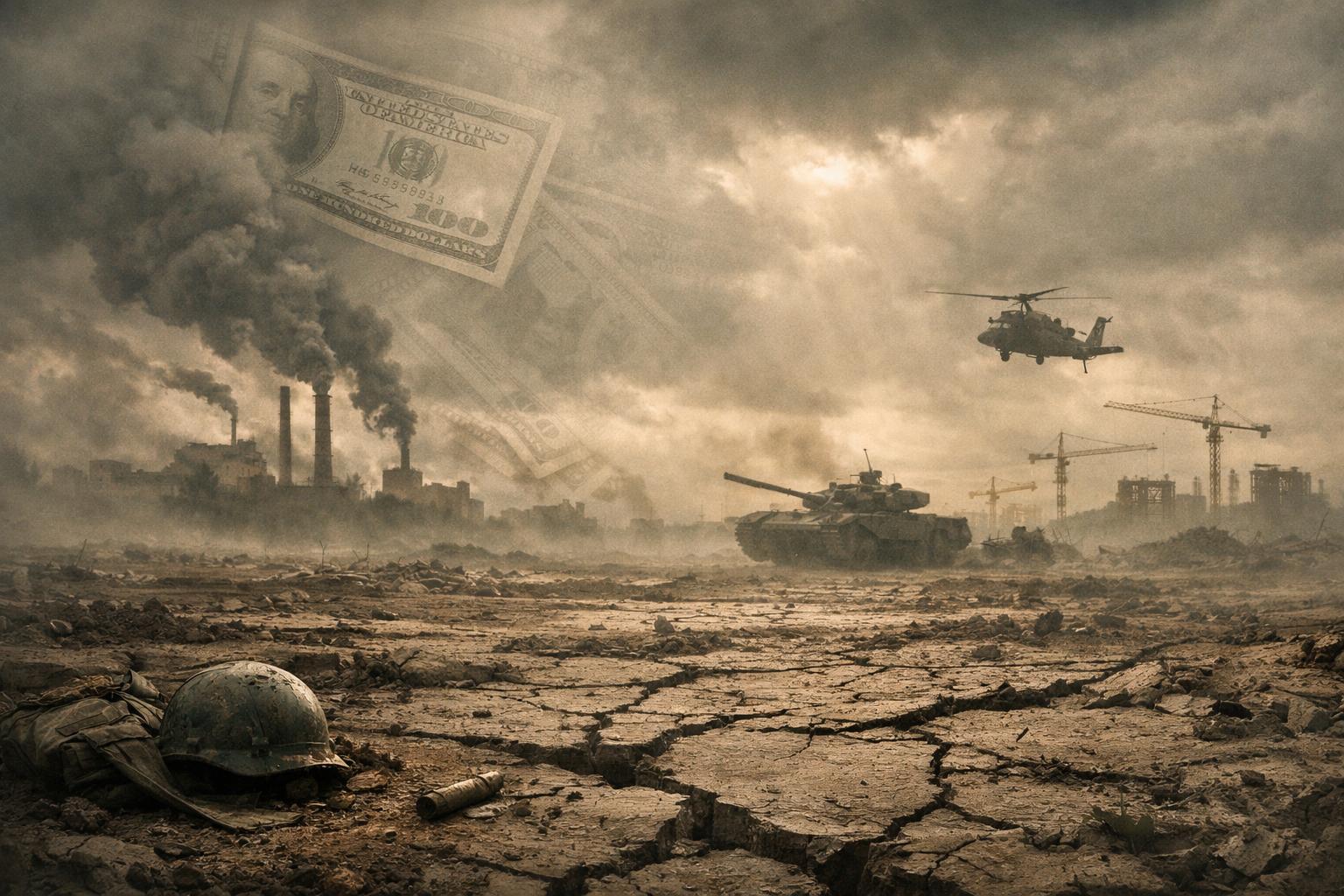
If we look at war honestly, without the language people use to soften it, we have to admit something uncomfortable: war creates winners in the financial sense. Someone sells the weapons. Someone transports them. Someone insures the shipments. Someone supplies the fuel. Someone manufactures the medicine, the equipment, the communications systems, the uniforms, the machinery, the food. Someone wins the contracts. Someone rebuilds what was destroyed. Someone gets paid at every stage.
That is one of the ugliest truths about the modern world.
War is not only a tragedy. It is also an industry.
And industries need demand.
That is why I struggle when people talk about war as though it were only the result of ideology, pride, religion, borders, or old hatred. Those things matter, of course. They are real forces. But they are also convenient explanations because they stay close to the surface. They describe the visible drama while leaving the machinery underneath untouched.
Profit is underneath.
Not always in the simplest, cartoonish way. Not every soldier is fighting for a shareholder. Not every politician is consciously thinking in terms of market share. Human beings are more complicated than that. History is more complicated than that. But when you follow the money, again and again, you find a structure that benefits from conflict long after the speeches have ended.
In capitalist systems especially, war becomes a kind of engine. It moves capital. It creates urgency. It justifies spending that would otherwise seem obscene. It turns destruction into opportunity. And once that logic is in motion, it is very difficult to stop because too many people begin to depend on it.
Even the language around war is polished to hide this. We call it defense spending. We call it reconstruction. We call it stabilization. We call it aid. Sometimes all of those words are true in part, but they also sound cleaner than what they often really are: a flow of money through broken places.
And broken places are profitable.
I do not say that lightly. I know how harsh that sounds. It is easier, and more comfortable, to believe war is simply the tragic failure of human judgment. That explanation preserves a little innocence. It lets us say, “No one wanted this.” But I think history keeps showing something more cynical: many people do want it, or at least want what it produces.
Not the suffering itself. Few would admit to that directly. But the profit from the suffering? Absolutely.
That is what makes war so morally corrosive. It doesn’t just destroy lives. It creates incentives for more destruction. It builds systems where peace can become less profitable than conflict. And once a society reaches that point, it has already crossed into dangerous territory.
I wish I could say this is just a theory, but it is hard not to see it everywhere. The same cycle repeats: fear, escalation, production, contract, destruction, rebuilding, payment, and then the quiet preparation for the next round. The language changes. The logos change. The names change. But the structure stays familiar.
So when I say that profit is the real reason for every single war, I mean this carefully: not always the only reason on the surface, but often the reason that makes the rest of it possible, sustainable, and worth continuing for those who benefit from it.
That is the part we should not let ourselves forget.
Because if there are no true winners in the human sense, there are still winners in the economic sense. And as long as that remains true, war will never be only an accident of history. It will remain a business.