I have been carrying a thought around for quite some time now, one that sits heavily yet simply: suppose we treat the Bible as the book of books, the absolute law, the only legitimate source of God’s will. Suppose further that anything not explicitly laid out within those pages is, by definition, lawless. If you hold both of those ideas firmly, the conclusion arrives rather awkwardly and almost immediately — Christianity, as both an institution and a lived reality, has been broken for almost as long as it has existed.
Table of Contents
What the premise demands
There is a certain clarity to the idea of a single, final authority. It promises stability, a firm shoreline amidst storms of opinion and novelty. Yet insisting that the Bible functions as an exhaustive legal code — that everything must exist within that book or else possess no moral or theological legitimacy — creates an inherently brittle structure. Life, history, and human communities are untidy things. They make decisions in circumstances the ancient texts never anticipated. They build liturgies, traditions, and institutions. They interpret, translate, and apply. And all of that is carried out through fallible people.
If one commits fully to the thought experiment above, the problem becomes unavoidable: the first congregations, the first pastors, the first councils and gatherings were human beings who interpreted, decided, and implemented. They introduced practices, established boundaries, granted authority, and excluded others. At every stage they were operating without the benefit of a complete social handbook for every new situation. That is not scandalous; it is simply the human condition. It does, however, make it inevitable that the interpretative process would introduce divergence from the simple rule of thumb: if it is not in the book, it is lawless.
Brokenness is not merely failing to follow the text
There is another layer to this that I cannot ignore: when human systems claim exclusive fidelity to a text whilst exercising power, hypocrisy and harm become remarkably easy to conceal. Declaring that the Bible alone constitutes law whilst simultaneously enforcing customs or policies the text itself never required becomes a form of moral sleight of hand. Whether those customs are liturgical, political, or social, they still shape behaviour and doctrine. People are judged, excluded, or punished in the name of an absolute text that is, in reality, being read through a highly particular lens.
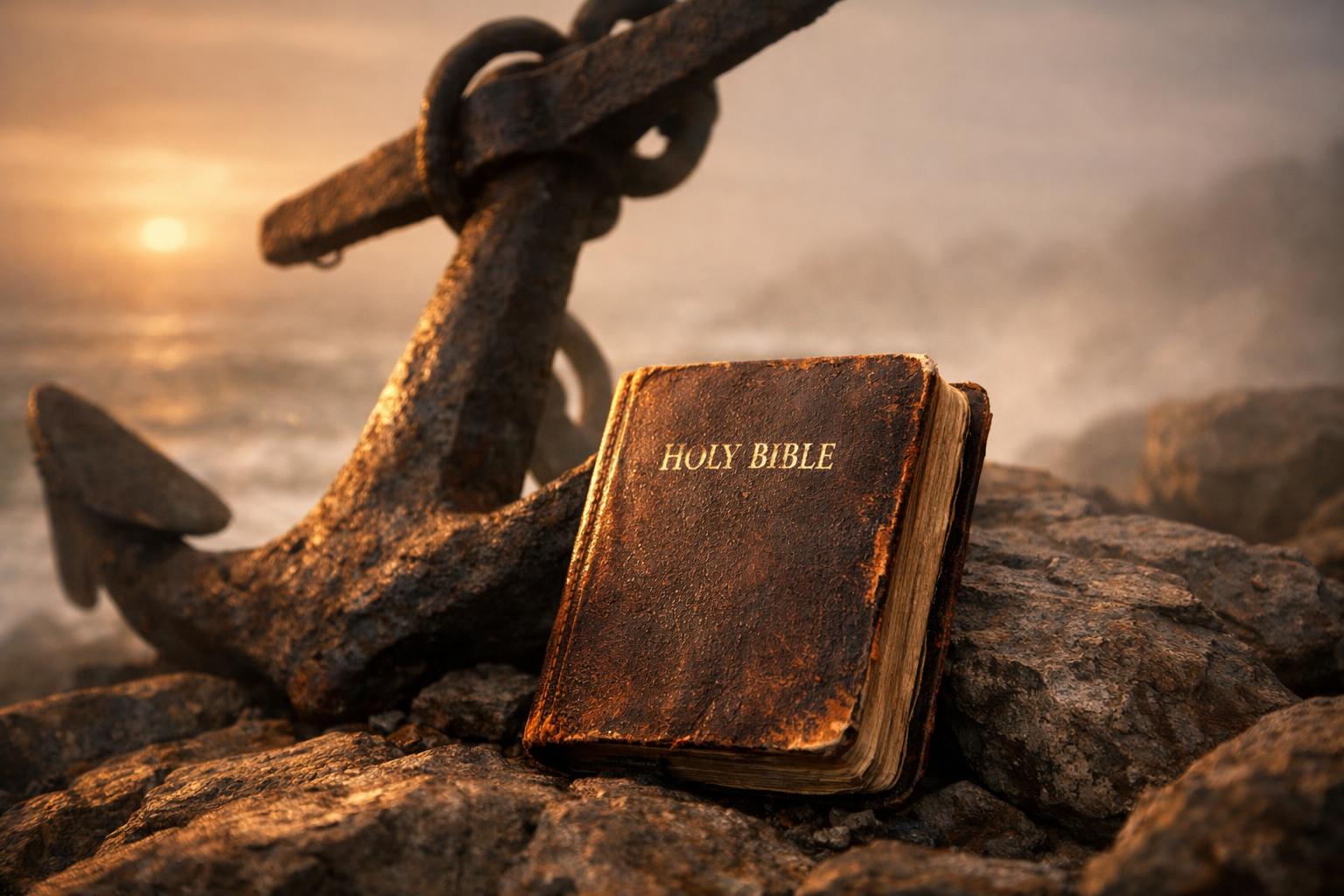
So when I say Christianity has been broken, I do not mean merely that Christians have erred privately. I mean that the institutional frameworks formed around interpretation, translation, and enforcement have frequently transformed the promise of an anchor into a weapon or a wall. Where the anchor ought to steady, it sometimes shackles. Where the text ought to guide, its interpretation can be bent by fear, ambition, or cultural convenience.
A living text and a living people
None of this is intended to deny the power or beauty of the Bible. There are passages within those pages that have soothed grief, ordered conscience, and inspired movements of justice and mercy. The book can and does function as an anchor in the finest sense — steadying, orientating, and true. The problem emerges when that anchor is fetishised into a literal, exhaustively comprehensive legal code, and when the living work of interpretation is dismissed as optional or illegitimate.
Scripture did not arrive in a vacuum. It was written, compiled, translated, and passed down by communities doing the best they could with the languages, philosophies, and power structures available to them. Reading it requires imagination and judgement. The moment we begin treating it as a sealed vending machine dispensing moral laws only when the correct coin is inserted, we lose the capacity to apply its deepest ethical impulses — love, mercy, humility — to new realities.
What repair looks like instead of retreat
This is where I ultimately land in practice. Acknowledging that Christianity has been broken in the ways described does not push me towards cynicism or wholesale rejection. Instead, it calls for something quieter and considerably more difficult: humility. Humility in interpretation. Humility in institutional power. A willingness to say, we were wrong here, and we must place repair above reputation.
Repair begins with taking the anchor seriously in spirit rather than wielding it as a cudgel. It looks like reading the texts carefully whilst admitting that no reader is the final reader. It looks like listening to voices historically marginalised within the tradition and asking whether our practices genuinely align with the moral through-lines we claim to honour. It looks like favouring mercy over ritual purity, justice over defensiveness.
It also means allowing the Bible to remain an anchor rather than insisting it be the only tool in the chest. Tradition, reason, pastoral wisdom, conscience, and the experiences of suffering communities are all sources that help a living faith navigate unfamiliar shores. Treating them as illegitimate simply because they are not spelled out line by line within an ancient text turns the Bible into an idol of narrowness rather than a foundation for a generous and courageous life.
A personal reckoning
For me, this is less an intellectual exercise than a moral one. I want institutions and communities capable of admitting where they have failed, capable of recognising the gap between claim and practice, and willing to take the more difficult path of humility. I want people who read the Bible as an anchor rooting them within a tradition of love and accountability, not as a final, exhaustive ledger absolving them of moral imagination.
If you believe the Bible should be treated as the final word, ask yourself what that finality truly demands of us — do we become guardians of a text, or stewards of a living moral vision? If you believe everything outside that text is lawless, ask whether such a posture cultivates human flourishing or merely fences it off. For me, the better reading keeps the anchor whilst freeing the hands to build, heal, and change.
We may call that hopeful. We may call it realistic. Either way, it requires courage to confess brokenness and then undertake the slow, unglamorous labour of repair. That, more than the purity of our rules, will reveal whether we are truly faithful to the spirit the Bible itself insists matters most: a life shaped by love, humility, and justice.