By Arsenio Di Donato
Death has a terrible public-relations problem.
For centuries we have portrayed the poor bastard as a skeleton wearing a black hood, carrying an agricultural implement large enough to make airport security nervous.
He is the Grim Reaper. The Angel of Death. The Harvester. In Hungarian, they call him Kaszás — essentially, the bloke with the scythe. Now everybody is supposed to be terrified of him.
But why? He doesn’t necessarily kill anybody. Perhaps he just takes us away.
Think about the metaphor we’ve given him. He’s a reaper. A farmer doesn’t walk into a wheat field screaming, “DIE, YOU EVIL WHEAT!” He harvests the crop when it is ready. Perhaps our skeletal friend isn’t the murderer at all.
Perhaps he’s transport, and if so, we’ve spent centuries blaming the driver.
Table of Contents
Death and Dying Are Not the Same Thing
I don’t think I’m particularly frightened of death.
Dying? That’s another matter entirely. There are plenty of ways of getting to Death’s front door that I would very much prefer to avoid. Cancer frightens me, long illnesses frighten me, pain frightens me, slowly losing control of my body frightens me.
Death itself? I’m considerably less certain that there’s anything there to fear. Of course, I can write that comfortably while sitting at my computer, with Death nowhere visibly nearby, but when the gentleman with the scythe actually knocks, my carefully constructed philosophy might instantly transform into:
“NOPE. NOPE. NOPE. WRONG HOUSE.”
That’s fine. Millions of years of biological survival instinct are unlikely to be defeated by an essay, but beneath that instinctive fear lies a stranger question.
What exactly am I frightened of?
The Great Human Argument
Humanity has spent thousands of years trying to work out what happens after death.
We’ve been impressively productive. We have heaven, hell, reincarnation, resurrection, souls, spirits, ghosts, purgatory, nothingness, cosmic consciousness, simulation theories and a kiometre long list of beliefs, then philosophy arrived and apparently decided the situation really needed more -isms.
Materialism, physicalism, dualism, idealism, panpsychism, existentialism, monism, pluralism, nihilism, and Probably several more isms currently hiding behind the sofa.
Each attempts, in one way or another, to explain what reality is, what consciousness is, and consequently what might happen when the biological machinery carrying us around stops working.
Religion has answers, philosophy has arguments, science has evidence, but they do not answer the same question.
What Do We Actually Know?
This is where I draw a line between belief and fact.
We know human bodies die, we know brains are intimately connected with consciousness as we experience it. Damage to particular areas of the brain can change perception. Memory can change, personality can change, consciousness itself can disappear under anaesthesia and return afterwards. Stop the brain permanently, and everything we can externally observe as that person’s mental activity eventually disappears.
Those are observations. Then comes the enormous leap.
Does the end of measurable brain activity mean the absolute end of subjective existence? Maybe. That’s an entirely reasonable possibility.
However here’s the awkward bit:
Nobody has experienced permanent non-existence and returned with laboratory notes:
“Interesting trip. Nothing there. Three stars.”
The moment consciousness permanently ceases, there is — by definition — nobody remaining to observe the absence of consciousness.
That creates a wonderfully peculiar problem.
If death is oblivion, you can never experience being dead.
There isn’t an endless black room, there isn’t silence, there isn’t loneliness, there isn’t even boredom. All of those require someone experiencing them.
There is simply no next experience, at least, if physicalism is correct.
And there we go again—another bloody ism.
Consciousness Is the Elephant in the Morgue
Before confidently explaining what happens to consciousness after death, there is one irritating little problem:
We still don’t completely understand what consciousness is.
We understand increasingly impressive amounts about the brain. We can observe neurons, measure electrical activity, watch regions activate. Alter consciousness chemically, suppress it with anaesthesia, damage it through injury, correlate subjective reports with neural activity.
All enormously important, but there remains a deceptively simple question:
Why does any of that produce an experience? Why aren’t we extraordinarily complicated biological machines operating entirely in the dark? Instead, it feels like something to be me. Right now, an internal observer is experiencing these words,and presumably there is one experiencing them while you read them.
Unless you’re an unusually sophisticated toaster. In which case, welcome.
The question of why physical processes are accompanied by subjective experience remains one of philosophy and neuroscience’s deepest problems, which makes claims about consciousness after death especially awkward.
We haven’t completely explained consciousness before death yet.
Then Physics Wanders In and Makes Everything Worse
As if philosophy hadn’t caused enough trouble, physics enters carrying spacetime.
One interpretation associated with relativity is often called the Block Universe. Very roughly, instead of imagining reality as a present moment continuously appearing while the past disappears and the future doesn’t yet exist, spacetime can be thought of as a four-dimensional structure containing events at different temporal locations. Your life becomes a worldline through spacetime. Birth at one end—death at the other.
This raises a peculiar question. When I die, do the earlier parts of my existence somehow stop existing? If I leave London and travel to Manchester, London doesn’t cease to exist merely because I’m no longer there.
Perhaps temporal locations aren’t as disposable as our everyday experience suggests.
Now, before anyone starts ordering immortality champagne:
This does not prove an afterlife.
A worldline can simply end. Block-universe ideas do not magically provide Heaven DLC, but they do complicate the intuitive statement:
“After death, I no longer exist anywhere.”
Perhaps every moment that constitutes your life remains exactly where it always was in spacetime, which is fascinating. And completely useless for determining what you’ll experience next. Thanks, physics, very helpful.
Maybe We’re Asking the Wrong Question
We constantly ask: “What happens to me after I die?”
Although perhaps the question itself assumes there must be an after. Maybe there is, maybe there isn’t. Imagine asking:
“What’s north of the North Pole?”
Perhaps asking what consciousness experiences after consciousness ceases is malformed. Or perhaps consciousness continues in some manner we haven’t even conceptualised.
Imagine explaining Wi-Fi to someone from 1200.
“Invisible information travels through the air and enters this rectangle.”
Witchcraft!
Burn him!
So I’m reluctant to assume that a primate brain which only recently worked out electricity has already established the final metaphysical architecture of existence. We’ve done rather well, but let’s retain some humility.
What If Death Isn’t the Villain?
Which brings me back to our hooded agricultural worker.
Perhaps Death isn’t evil. Maybe he doesn’t choose when you die, maybe he simply arrives when it’s time. He’s not an executioner. He’s a collector, transport, cosmic Uber.
Your biological reservation has ended, and somebody has come for the keys. That changes the symbolism completely. The frightening skeleton becomes a reminder rather than a threat:
You are temporary.
Not necessarily your consciousness, not necessarily whatever metaphysical thing philosophers want to argue about next Tuesday, but this particular biological arrangement called you has a limited booking.
Perhaps that’s precisely what gives it value. An unlimited number of tomorrows would make today remarkably cheap.
My Attempt at Immortality
I write books, articles, ideas, stories. I make music. I maintain an archive of my life and work partly because creating things is what I do.
However there is another reason:
I’m leaving breadcrumbs. I know perfectly well that publishing a book doesn’t make my consciousness immortal. I’m not going to pretend otherwise, but information can survive its creator.
Someone I’ve never met can read something I wrote decades ago and temporarily reconstruct a thought that once existed inside my head.
That’s extraordinary when you think about it. My brain produces a pattern. I convert it into language. Language becomes marks.
Years later another brain encounters those marks, and something resembling my original thought appears inside another conscious mind.
Not immortality, but certainly not nothing.
Perhaps that’s enough.
So What Happens When We Die?
After religion, philosophy, neuroscience, physics, metaphysics, consciousness studies and several thousand years of extremely intelligent people arguing with one another, I have carefully considered the available evidence, and I have reached my conclusion:
No bloody idea.
Neither does anyone else. People believe, people theorise, people hope, people fear, people construct beautiful philosophical arguments.
Scientists measure what can be measured, religions provide answers based upon faith and revelation, philosophers continue producing isms at an industrial rate.
Maybe consciousness ends, maybe something continues, maybe reincarnation awaits, maybe we’re information inside some larger structure, maybe Death opens the door and says:
“Congratulations. Tutorial completed.”
I don’t know. And I’m increasingly comfortable with that.
There are questions where “I don’t know” isn’t intellectual failure. It’s intellectual honesty. One day, barring some spectacular technological development, I’ll find out as much as I can.
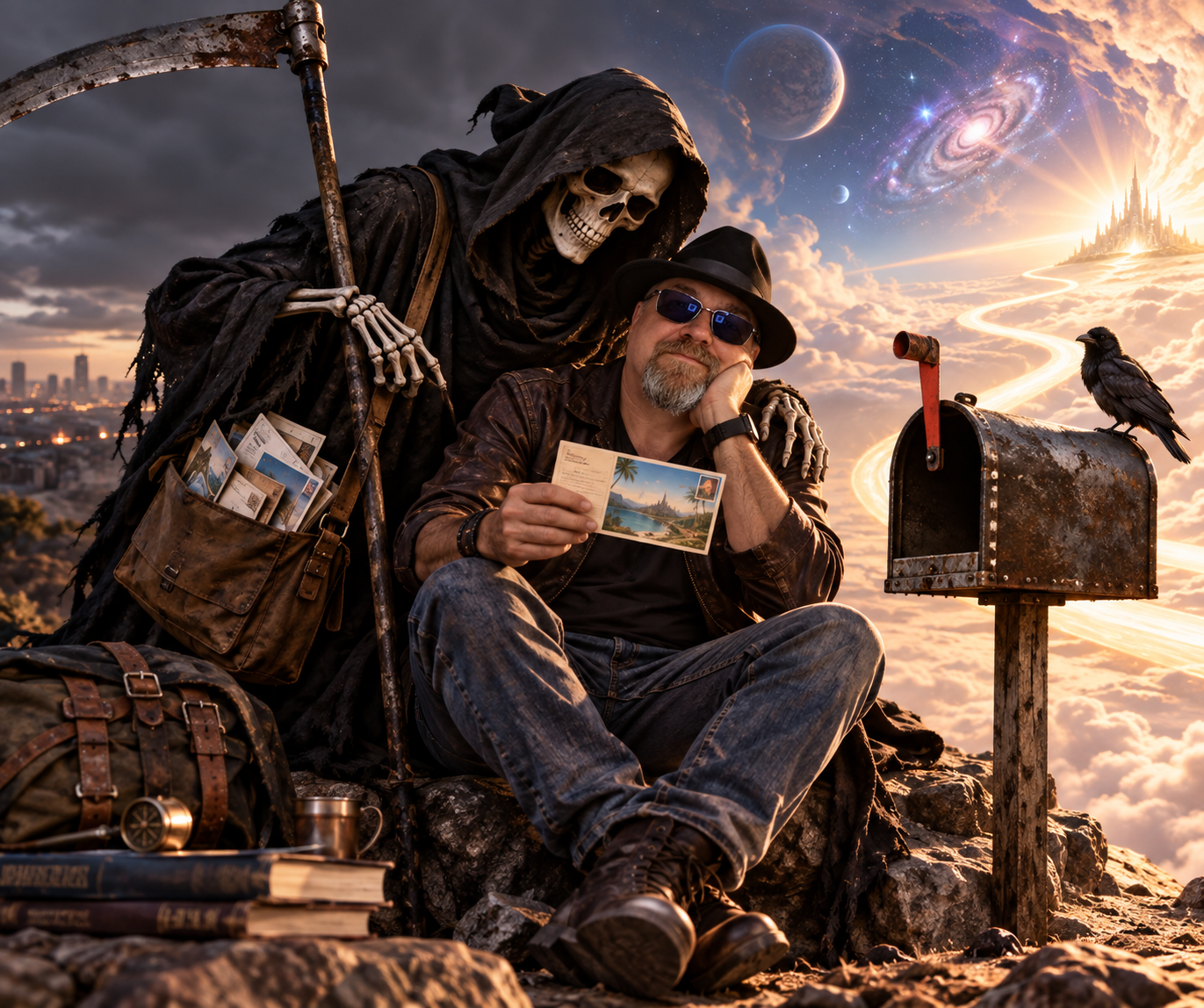
Perhaps I’ll meet the Grim Reaper, hopefully he’ll forgive me for keeping a figurine of him on my shelf. Perhaps he’ll lead me somewhere astonishing, perhaps there will simply be no next moment.
Either way, worrying about the unknowable destination seems considerably less useful than doing something worthwhile before departure.
So I’ll keep writing, I’ll keep making music, I’ll keep thinking, I’ll keep leaving breadcrumbs, and when eventually I pass that great metaphysical road sign saying:
YOU ARE NOT IN KANSAS ANYMORE
I’ll finally have my answer, and if there’s a postal service on the other side,
I’ll send you a postcard.
Be First to Comment